UK to see higher growth than expected in 2025: EY


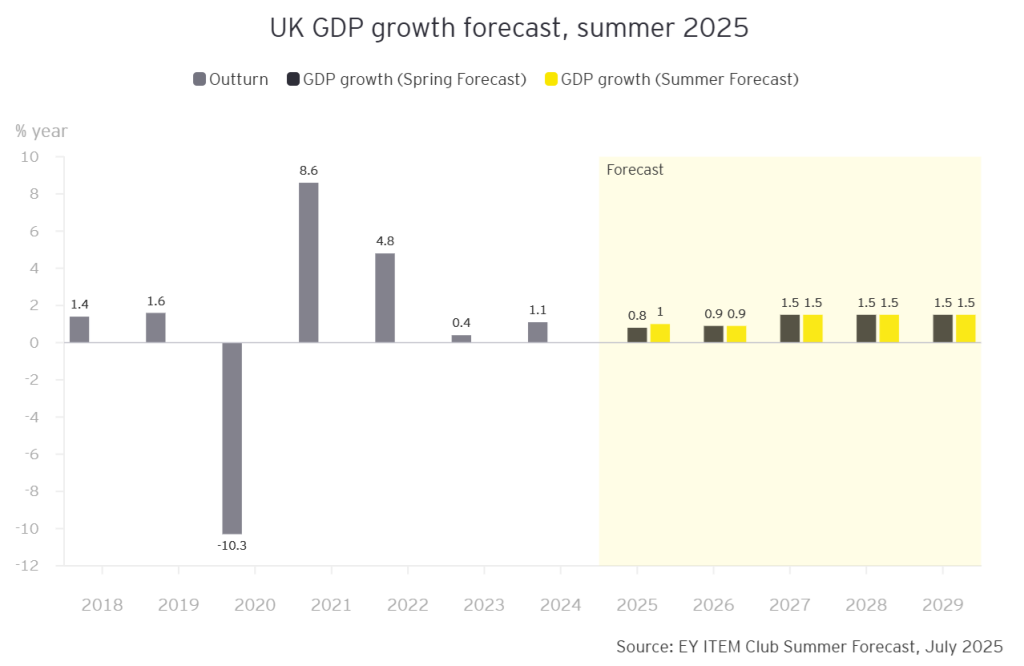
The EY Item Club has upgraded its forecast for UK GDP growth in 2025 from 0.8% to 1%, following a stronger-than-expected start to the year.
However, the group predicts that persistent uncertainty in the global economy and international trade policy, alongside tightening fiscal policy, a weakening labour market and the lagged effect of higher interest rates, will weigh on economic momentum. These factors will combine to delay the UK’s return to more moderate levels of growth.
UK GDP growth is expected to remain subdued at 0.9% in 2026, before rising to 1.5% in 2027, matching the predictions made in April’s Spring Forecast.
Growth in the first quarter of 2025 was particularly strong and was driven by a significant increase in business investment, which rose by 3.9% in Q1. However, this is thought to partly reflect the acceleration of business investment and purchase decisions by some companies in March, ahead of the implementation of US tariffs in April.
This flurry of business spending at the start of the year has led the EY ITEM Club to upgrade its expectations for business investment growth in 2025 to 1.3%, up from 0.3%.
However, this level of growth is unlikely to be sustained into the second half of 2025 or into 2026, with US tariffs expected to impact some UK exports and prompt some businesses to pause spending decisions amid heightened levels of uncertainty.
Against this backdrop, business investment growth is expected to be flat at 0.0% in 2026, down from expectations of 1.0% growth in April’s Spring Forecast, before rebounding to 1.8% growth in 2027.
“After a strong start to the year, uncertainty in the global economy and international trade policy has continued to slow momentum. While the agreement struck with the US offers welcome relief to certain sectors and boosts the trading outlook, the UK’s access to a key export market is still reduced from where it was at the start of 2025, which is likely to weigh on growth,” said Anna Anthony, EY UK & Ireland Regional Managing Partner.
Business investment is expected to remain modest until 2027 and while interest rate cuts should reduce debt service costs and make financing cheaper, this will take time to materialise, she said.
“Until then, businesses face a period of international uncertainty, alongside elevated labour and energy costs. Stimulating greater economic growth through business investment will require policy measures that actively incentivise companies to spend, even under challenging conditions.”