How much money people make ‘house flipping’ in the UK


Property flipping (a home bought and sold within 12 months) has fallen out of favour, and the proportion of flipped properties across England and Wales in the first three months of this year was the lowest for 11 years.
This is according to new data from property firm Hamptons, which says that the changes around stamp duty and other a general decline in house values are responsible for the downward trend.
“In number terms, this translates to 7,301 flipped properties in the first quarter of 2025 (Q1 2025), some 27% below the 10-year average of 10,000 homes for the first quarter of a year,” Hamptons said.
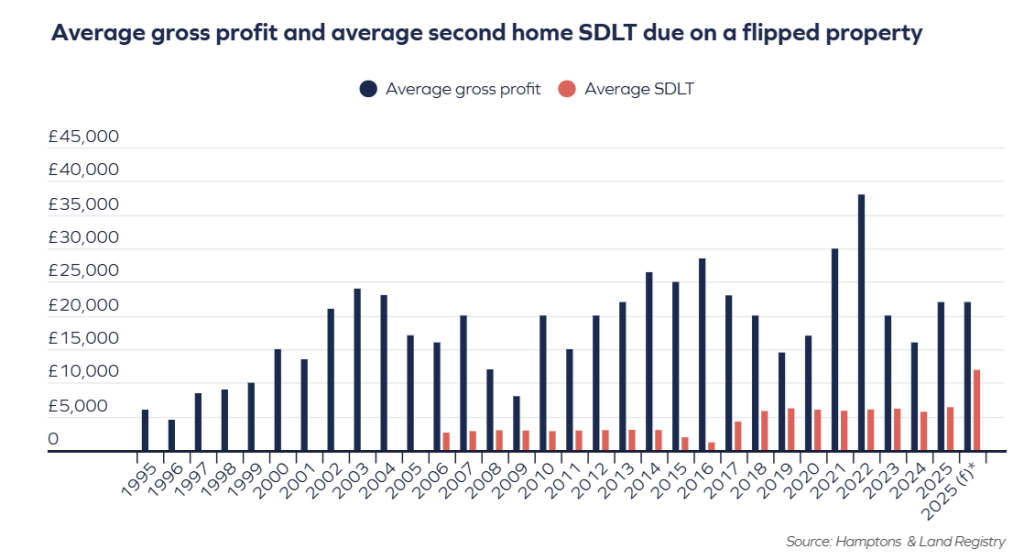
This is linked to the average gross profit (that is, the difference between sale and purchase price) earned on a flipped property, which has been steadily eroded, the group said.
In Q1 2025 the average gross profit on a flipped property in England and Wales was £22,000. This is significantly lower than the most recent peak of £38,000 achieved in 2022.
“To put it another way, in percentage terms, the average gross profit made by an investor flipping a home fell from 17% in Q1 2015 to 10% in Q1 2025. Weaker house price growth is the primary reason for the fall and stamp duty (SDLT) reduces margins further down the line,” the group said.
Property taxes bite
It added that stamp duty is becoming increasingly costly and it’s eating into investor profits.
“Back in 2015, an investor would have paid the same SDLT on a property as someone buying a home in which to live (an owner-occupier). This meant that the average SDLT bill in the first quarter of 2015 amounted to £1,900. But since then, there have been many stamp duty changes, most notably the introduction of Higher Rates for Additional Dwellings (HRAD).”
This means that the average SDLT payable on a flipped home in the first three months of this year has increased significantly. In fact by 236% compared to Q1 2025. Or to put it another way, an investor who sold in Q1 2025, saw an average (median) 21% of their gross profit go towards paying stamp duty.
Furthermore, in April 2025 the nil-rate SDLT threshold fell to £125,000 from £250,000. Based on Q1 2025 sales, the average SDLT bill for an investor contemplating flipping a home today will rise to £11,920.
Assuming no behavioural change, SDLT now costs the average person flipping a home in England and Wales a record 30% of their gross profit. And this before any money has been spent on improving the property.
“Profit margins are clearly getting thinner. In fact, in the first quarter of this year, the average net profit (gross profit – stamp duty) made on a flipped property fell to £12,000.
“This represents a net return of 7% on the purchase price. To contrast, in Q1 2015, the average gross profit equated to £28,500 or a 16% net return. It’s no surprise that as a consequence, the number of flipped homes has fallen,” the group said.
Of all the homes flipped across England and Wales during the first quarter of this year, 80% were sold for more than they were bought for; however, just 66% made a profit on resale after paying stamp duty.
Higher building material and labour costs, alongside slower house price growth, have also weighed heavily on investors. Flipping increasingly only stacks up in the Midlands and North of England, where property prices and, therefore, stamp duty costs are lower.