51% of Labour voters in favour of higher taxes ahead of Spending Review


On Wednesday 11 June, Chancellor Rachel Reeves will report the outcome of the 2025 Spending Review, which will determine day-to-day spending for government departments for the next three financial years, as well as spending on planned investments for the next four.
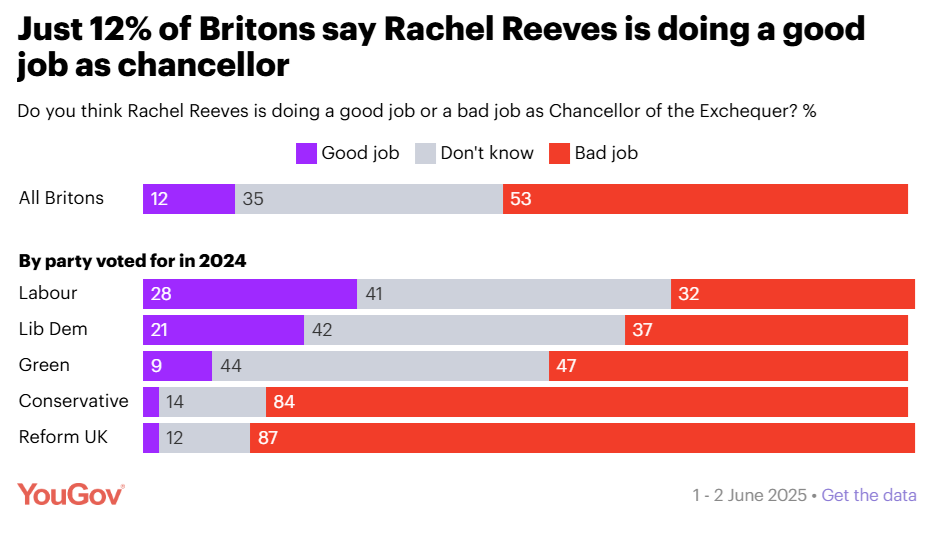
This review is against a difficult backdrop for Rachel Reeves, with YouGov polling for Sky News showing that just 12% of Britons believe she is doing a good job as chancellor, while a majority (53%) feel she is doing poorly in the role.
Even among Labour voters, just 28% are positive about Reeves’ tenure at the Treasury, while a similar 32% feel she is doing a bad job as chancellor.
Do Brits support increases to taxes, spending or borrowing?
A key focus of the Spending Review will be how the government plans to distribute funding. As is almost always the case for any government, there won’t be enough to go around. This means the government will either need to cut or find somewhere else to get the money.
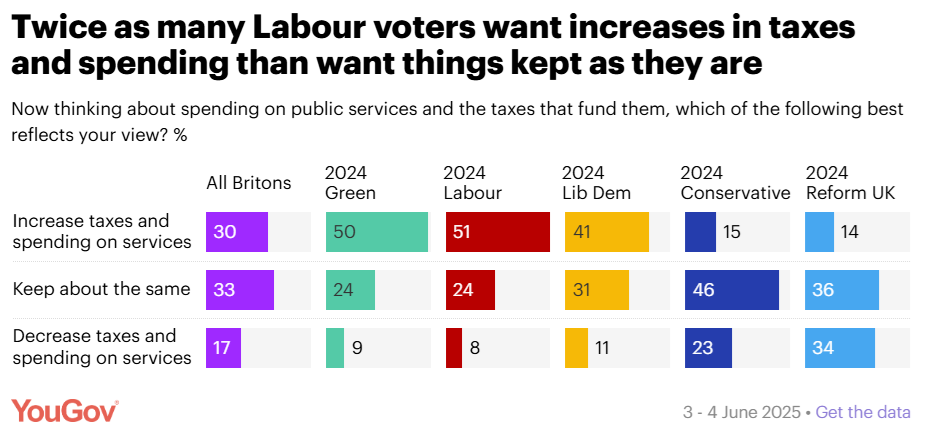
As a whole, Britons are divided on what the government’s overall tax and spend strategy should be. YouGov polling for The Times shows a third (33%) would like overall levels to stay roughly where they are, while a similar 30% would like to see an increase in spending on public services, even if this means an increase in taxes. A smaller 17% of the public would choose tax cuts at the expense of spending.
Among Labour voters, though, things lean more towards more spending, with 51% favouring increases to taxes and spending, roughly twice the 24% who want levels to remain about the same. A similar picture can be seen among Green voters (50% vs 24%), while Lib Dems also lean towards increases over existing levels by a margin of 41% to 31%.
By contrast, nearly half of Conservative voters (46%) want levels to remain broadly where they are, relative to 23% who favour cuts and 15% who want increases. Reform UK voters are split 36% to 34% between existing levels and cuts to both taxes and spending.
“The problem for Reeves is that Labour’s pre-election promises not to cut back key services, not to raise taxes on working people and not to increase government borrowing are all increasingly difficult to fulfil, meaning that at least one may have to be broken,” said YouGov.
“Of the three contradictory stances, 37% of Britons say it is best the government avoid cuts to services, even if it means rises in the other two.”
“This compares to 29% who would rather the government avoids tax rises, even if this meant spending cuts or increased borrowing, and 16% would prefer the government to avoid borrowing more, even if this means spending cuts or tax increases,” the group said.
Again, Labour voters opt for prioritising services, with 55% saying they’d prefer the government to avoid cuts at all costs, a stance also held by 58% of Lib Dems and 63% of Green voters.
Reform UK and Conservative voters, however, tend to favour avoiding tax rises, with 46% of Reform voters and 40% of Conservatives believing they should be prevented, even if that means spending cuts or borrowing increases.