New data shows Starmer and Badenoch won’t be in charge next election – what you should know


New data published by UK think tank More in Common shows that the country faces increased political fragmentation as it enters into a new era of multi-party politics. This is likely to have long-term repercussions and might ultimately result in Keir Starmer and Kemi Badenoch losing their seats ahead of the next general election.
The data, which is based on the UK’s April 2025 local election results, shows a dramatic shift away from Britain’s largest parties and towards Reform UK and the Liberal Democrats.
Notably, these county elections were held in more traditionally Conservative areas, and the Conservatives suffered historic and dramatic defeats – losing all 16 of the councils they controlled going into the election.
The biggest winner is Reform, which is advancing on Tory and Labour territory. More in Common’s data shows that just 42% of Reform’s current voters came from their 2024 voter base. Beyond this, the party has gained support from the Tories and Labour.
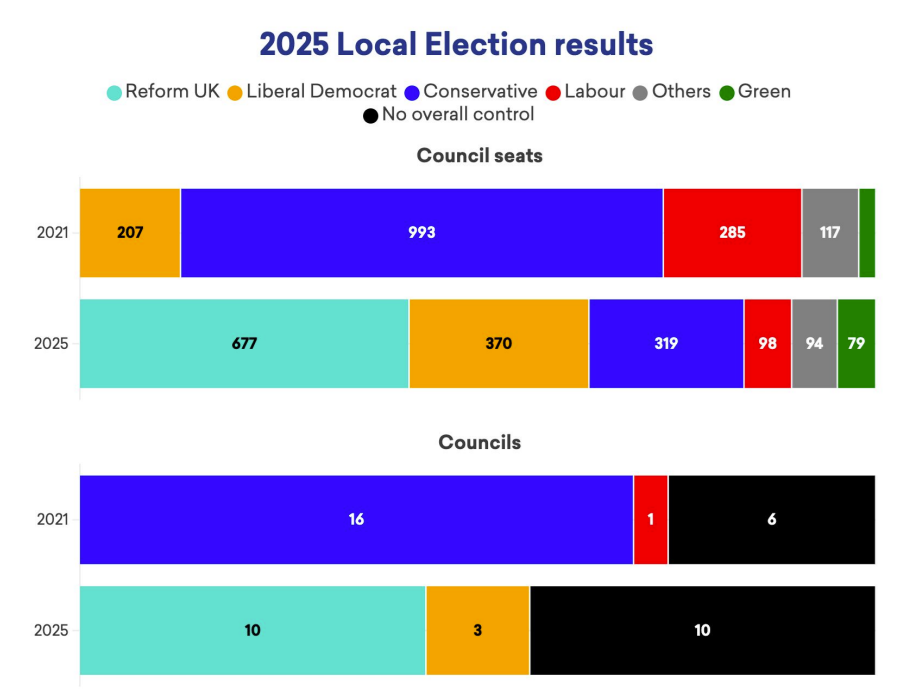
While this might indicate that UK voters are veering right in their preferences, the data instead shows that it is smaller parties which are pulling votes away from Labour and the Conservatives. “The Liberal Democrats continue to advance into blue wall seats in the south, particularly in areas they gained in the general election. Their vote continues to be concentrated and efficient,” the think tank said.
By comparison, the Tories are subject to a devastating pincer movement, losing to Reform across the country and the Liberal Democrats in the South. While this would traditionally be good news for the current Labour government, the data shows that voters are also growing disenfranchised with Starmer’s leadership.
“The public is losing faith in Labour’s ability to deliver change, and voters want to give them a ‘kick up the bum’. Without a split on the right, the results could have been worse,” More in Common said.
The future of UK leadership
The results show clear uncertainty about Kemi Badenoch’s future as Conservative leader. Just 4% of voters think Badenoch will be Prime Minister after the next election, while 45% don’t think she will still be Tory leader at the next election. 46% of Conservative supporters think Badenoch is doing a worse job as party leader than Boris Johnson, while 42% think she is worse than Rishi Sunak.
However, Badenoch’s ‘don’t knows’ remain high across poll questions and focus groups. This suggests her underperformance is largely a product of being unknown or not cutting through to the public rather than a dislike of her as leader, More in Common said.
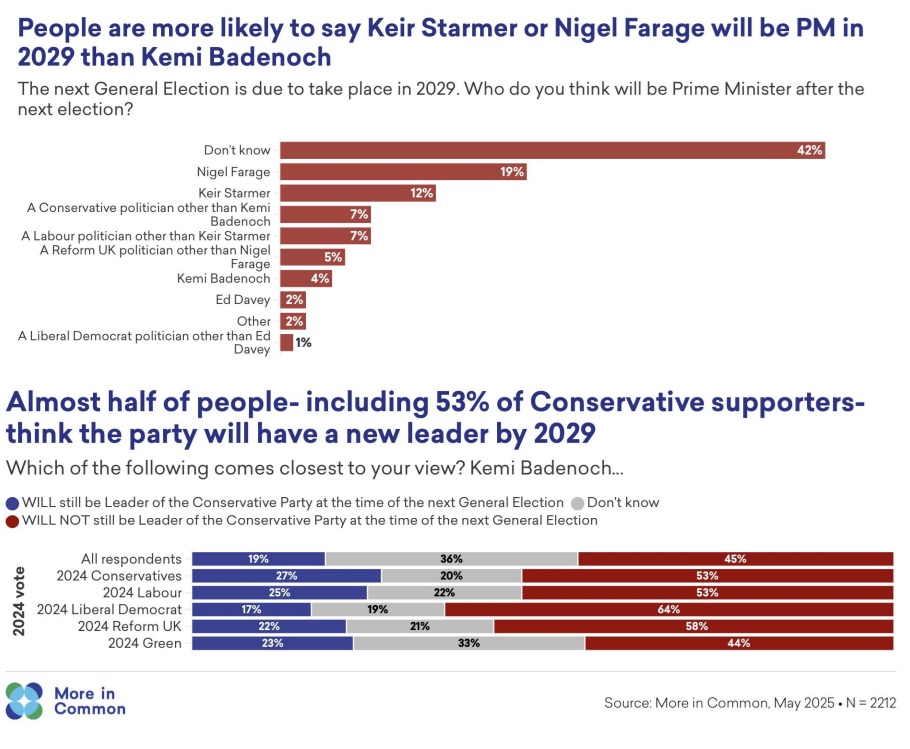
While this should be seen as a positive for current Prime Minister Keir Starmer, the data shows that there is also clear uncertainty about his future leadership. Asked about the most likely outcome of the next election, Reform’s Nigel Farage has surpassed Labour as the public’s most probable Prime Minister, and a third of respondents (33%) now expect Reform UK to be in government.
Nearly six in 10 respondents do not now expect Keir Starmer to be Prime Minister by the time of the next general election, and only 31% expect the government to be re-elected.